Modül 2: Otomotiv Protokolleri ve İletişim Sistemleri
Konular
İlerleme0%
Hafta 5: CAN Bus Temelleri ve Frame Yapısı
Hafta 5: CAN Bus Temelleri ve Frame Yapısı
🎯 Öğrenme Hedefleri
Bu haftanın sonunda:
- CAN Bus'un tarihi ve çalışma prensiplerini anlayacaksınız
- CAN Frame yapısını detaylı öğreneceksiniz
- Classical CAN ve CAN FD farklarını kavrayacaksınız
- python-can kütüphanesi ile mesaj gönderip alabileceksiniz
1. CAN Bus Nedir?
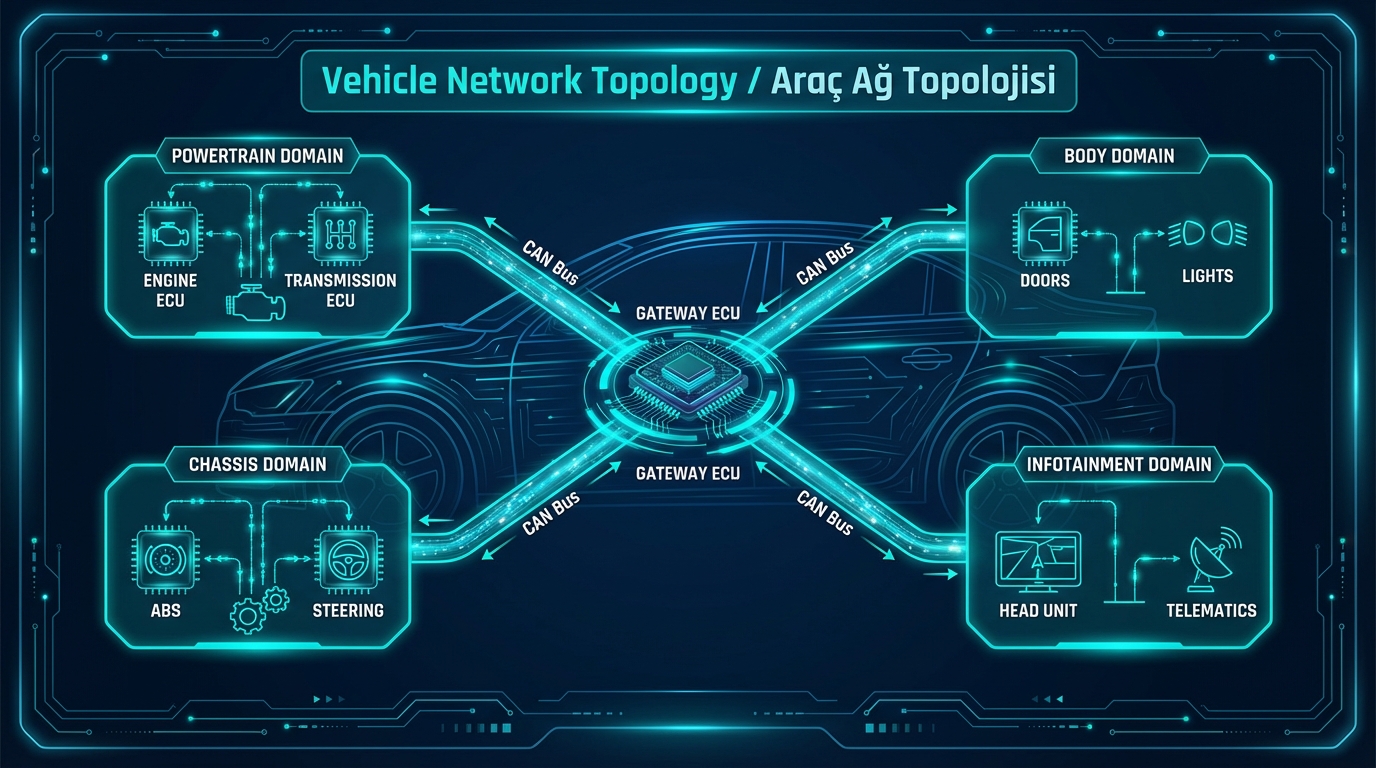
Şekil: Modern bir araçtaki ECU'ların CAN bus üzerinden bağlantısını gösteren ağ topolojisi diyagramı.
1.1 Tarihçe ve Gelişim
📅 CAN Bus Tarihi:
├── 1983: Robert Bosch GmbH tarafından geliştirilmeye başlandı
├── 1986: Resmi olarak tanıtıldı (SAE Congress)
├── 1987: İlk CAN chip'leri (Intel 82526, Philips 82C200)
├── 1991: Mercedes-Benz W140 - ilk seri üretim CAN uygulaması
├── 1993: ISO 11898 standardı yayınlandı
├── 2012: CAN FD (Flexible Data-rate) tanıtıldı
├── 2015: ISO 11898-1:2015 (CAN FD dahil)
└── 2020+: CAN XL geliştirme (10+ Mbps)
1.2 CAN Bus Neden Kullanılır?
| Özellik | Açıklama | |---------|----------| | Daha Az Kablo | Tek bir veri yolu üzerinden tüm ECU'lar iletişim kurar | | Güvenilirlik | Hata tespiti ve düzeltme mekanizmaları | | Gerçek Zamanlı | Deterministik önceliklendirme (arbitration) | | Maliyet | Basit donanım gereksinimleri | | Esneklik | Yeni ECU ekleme kolay |
1.3 Fiziksel Katman
                CAN Bus Fiziksel Bağlantı

     ECU 1        ECU 2        ECU 3        ECU 4
       │           │           │           │
    ╔══╩══╗    ╔══╩══╗    ╔══╩══╗    ╔══╩══╗
    ║ CAN ║    ║ CAN ║    ║ CAN ║    ║ CAN ║
    ║Trans║    ║Trans║    ║Trans║    ║Trans║
    ╚═┬═┬═╝    ╚═┬═┬═╝    ╚═┬═┬═╝    ╚═┬═┬═╝
       │ │        │ │        │ │        │ │
    ═══┼─┼═══════┼─┼═══════┼─┼═══════┼─┼═══ CAN_H (Yüksek)
    ═══┼─┼═══════┼─┼═══════┼─┼═══════┼─┼═══ CAN_L (Düşük)
       │              │              │              │
      120Ω           (iç)           (iç)          120Ω
    Terminator                              Terminator

    Dominant (0): CAN_H = 3.5V, CAN_L = 1.5V (Fark = 2V)
    Recessive (1): CAN_H = 2.5V, CAN_L = 2.5V (Fark = 0V)
2. CAN Frame Yapısı
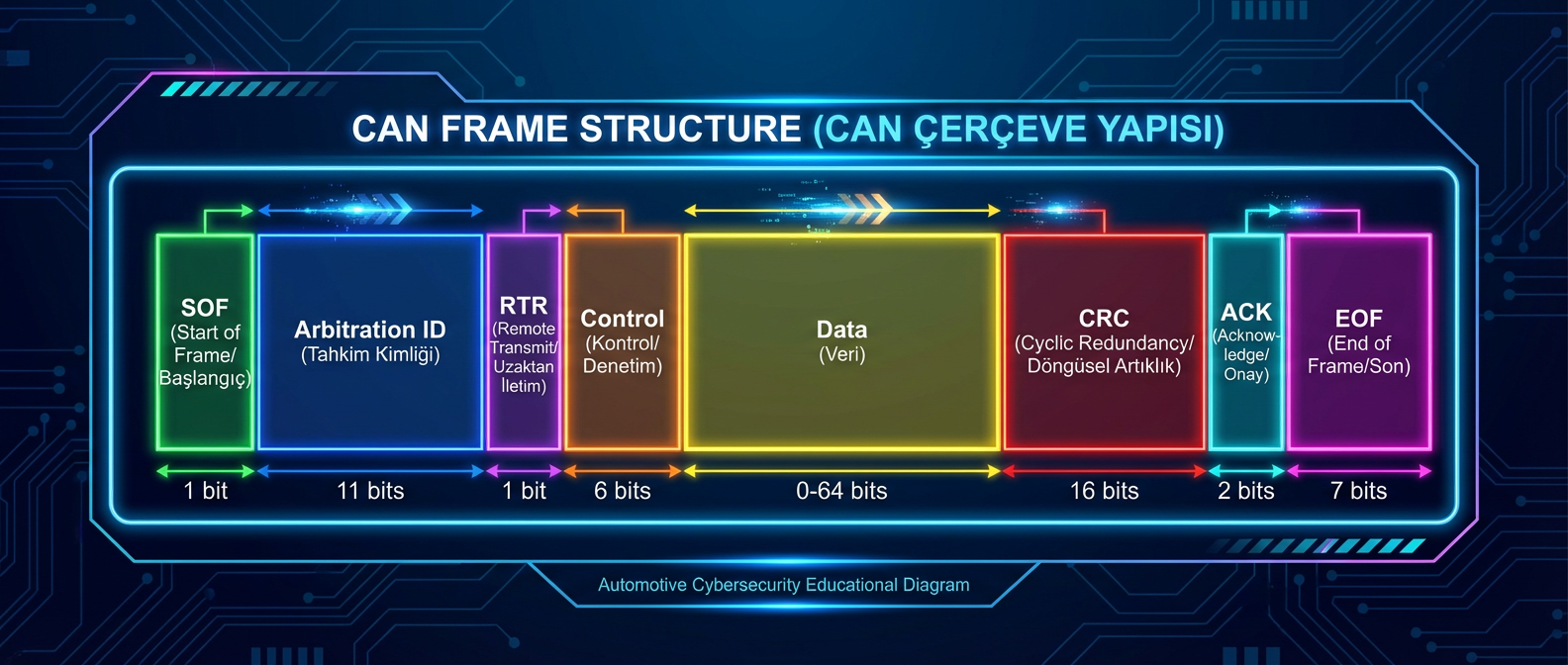
2.1 Standart CAN Frame (11-bit ID)
┌─────┬────────────────┬─────┬─────┬───┬─────┬───────────┬───────┬─────┬─────┐
│ SOF │ Arbitration ID │ RTR │ IDE │ r0│ DLC │   DATA    │  CRC  │ ACK │ EOF │
│ 1   │     11 bit     │  1  │  1  │ 1 │  4  │ 0-64 bit  │ 15+1  │ 2   │  7  │
└─────┴────────────────┴─────┴─────┴───┴─────┴───────────┴───────┴─────┴─────┘

• SOF (Start of Frame): Mesaj başlangıcı, dominant bit (0)
• Arbitration ID: Mesaj önceliği (düşük değer = yüksek öncelik)
• RTR (Remote Transmission Request): 0 = Data frame, 1 = Remote frame
• IDE (Identifier Extension): 0 = Standard (11-bit), 1 = Extended (29-bit)
• r0: Rezerve (0)
• DLC (Data Length Code): Veri uzunluğu (0-8 byte)
• DATA: Mesaj verisi (0-8 byte, her byte 8 bit)
• CRC: Cyclic Redundancy Check (15 bit + 1 bit delimiter)
• ACK: Acknowledgement (1 bit ACK + 1 bit delimiter)
• EOF (End of Frame): 7 recessive bit
2.2 Python ile CAN Frame Analizi
#!/usr/bin/env python3
"""
CAN Frame Yapısı Analizi
"""

from dataclasses import dataclass
from typing import List, Optional
from enum import IntEnum

class DLC(IntEnum):
    """Data Length Code - CAN FD için."""
    DLC_0 = 0
    DLC_1 = 1
    DLC_2 = 2
    DLC_3 = 3
    DLC_4 = 4
    DLC_5 = 5
    DLC_6 = 6
    DLC_7 = 7
    DLC_8 = 8
    DLC_12 = 9   # CAN FD
    DLC_16 = 10  # CAN FD
    DLC_20 = 11  # CAN FD
    DLC_24 = 12  # CAN FD
    DLC_32 = 13  # CAN FD
    DLC_48 = 14  # CAN FD
    DLC_64 = 15  # CAN FD

    @property
    def bytes(self) -> int:
        """DLC değerine karşılık gelen byte sayısı."""
        mapping = {0:0, 1:1, 2:2, 3:3, 4:4, 5:5, 6:6, 7:7, 8:8,
                   9:12, 10:16, 11:20, 12:24, 13:32, 14:48, 15:64}
        return mapping.get(self.value, 0)

@dataclass
class CANFrame:
    """CAN Frame veri yapısı."""
    arbitration_id: int
    data: bytes
    is_extended_id: bool = False
    is_remote_frame: bool = False
    is_fd: bool = False
    bitrate_switch: bool = False  # CAN FD BRS
    error_state_indicator: bool = False  # CAN FD ESI
    timestamp: float = 0.0

    @property
    def dlc(self) -> int:
        """Data Length Code."""
        return len(self.data)

    @property
    def id_type(self) -> str:
        """ID tipi."""
        return "Extended (29-bit)" if self.is_extended_id else "Standard (11-bit)"

    @property
    def frame_type(self) -> str:
        """Frame tipi."""
        if self.is_fd:
            return "CAN FD"
        elif self.is_remote_frame:
            return "Remote"
        else:
            return "Data"

    def to_hex_string(self) -> str:
        """Frame'i hex string olarak formatla."""
        id_format = f"0x{self.arbitration_id:08X}" if self.is_extended_id else f"0x{self.arbitration_id:03X}"
        data_hex = ' '.join(f'{b:02X}' for b in self.data)
        return f"{id_format} [{self.dlc}] {data_hex}"

    def analyze(self) -> dict:
        """Frame'i analiz et."""
        analysis = {
            "id": hex(self.arbitration_id),
            "id_type": self.id_type,
            "frame_type": self.frame_type,
            "dlc": self.dlc,
            "data_hex": self.data.hex().upper(),
            "data_ascii": ''.join(chr(b) if 32 <= b < 127 else '.' for b in self.data),
        }

        # UDS analizi
        if len(self.data) >= 2:
            first_byte = self.data[0]
            second_byte = self.data[1]

            # Single Frame (SF)
            if (first_byte & 0xF0) == 0x00:
                sf_length = first_byte & 0x0F
                analysis["iso_tp"] = f"Single Frame, Length: {sf_length}"
                if sf_length >= 1:
                    service_id = second_byte
                    analysis["uds_service"] = self._identify_uds_service(service_id)

            # First Frame (FF)
            elif (first_byte & 0xF0) == 0x10:
                ff_length = ((first_byte & 0x0F) << 8) | second_byte
                analysis["iso_tp"] = f"First Frame, Total Length: {ff_length}"

            # Consecutive Frame (CF)
            elif (first_byte & 0xF0) == 0x20:
                seq_num = first_byte & 0x0F
                analysis["iso_tp"] = f"Consecutive Frame, Sequence: {seq_num}"

            # Flow Control (FC)
            elif (first_byte & 0xF0) == 0x30:
                flow_status = first_byte & 0x0F
                status_map = {0: "CTS (Continue To Send)", 1: "Wait", 2: "Overflow"}
                analysis["iso_tp"] = f"Flow Control, Status: {status_map.get(flow_status, 'Unknown')}"

        return analysis

    def _identify_uds_service(self, service_id: int) -> str:
        """UDS servisini tanımla."""
        services = {
            0x10: "DiagnosticSessionControl",
            0x11: "ECUReset",
            0x14: "ClearDiagnosticInformation",
            0x19: "ReadDTCInformation",
            0x22: "ReadDataByIdentifier",
            0x23: "ReadMemoryByAddress",
            0x24: "ReadScalingDataByIdentifier",
            0x27: "SecurityAccess",
            0x28: "CommunicationControl",
            0x2A: "ReadDataByPeriodicIdentifier",
            0x2C: "DynamicallyDefineDataIdentifier",
            0x2E: "WriteDataByIdentifier",
            0x2F: "InputOutputControlByIdentifier",
            0x31: "RoutineControl",
            0x34: "RequestDownload",
            0x35: "RequestUpload",
            0x36: "TransferData",
            0x37: "RequestTransferExit",
            0x38: "RequestFileTransfer",
            0x3E: "TesterPresent",
            0x85: "ControlDTCSetting",
            # Pozitif yanıtlar
            0x50: "DiagnosticSessionControl (+)",
            0x51: "ECUReset (+)",
            0x62: "ReadDataByIdentifier (+)",
            0x67: "SecurityAccess (+)",
            0x6E: "WriteDataByIdentifier (+)",
            0x71: "RoutineControl (+)",
            0x7E: "TesterPresent (+)",
            0x7F: "Negative Response",
        }
        return services.get(service_id, f"Unknown (0x{service_id:02X})")

# Demo
if __name__ == "__main__":
    print("📡 CAN FRAME ANALİZ DEMO")
    print("=" * 60)

    # Örnek frameler
    frames = [
        CANFrame(0x7E0, bytes([0x02, 0x10, 0x01, 0x00, 0x00, 0x00, 0x00, 0x00])),
        CANFrame(0x7E8, bytes([0x02, 0x50, 0x01, 0x00, 0x00, 0x00, 0x00, 0x00])),
        CANFrame(0x7E0, bytes([0x03, 0x22, 0xF1, 0x90, 0x00, 0x00, 0x00, 0x00])),
        CANFrame(0x7E8, bytes([0x10, 0x14, 0x62, 0xF1, 0x90, 0x57, 0x42, 0x41])),
        CANFrame(0x7E0, bytes([0x30, 0x00, 0x14, 0x00, 0x00, 0x00, 0x00, 0x00])),
        CANFrame(0x7E8, bytes([0x21, 0x33, 0x41, 0x35, 0x47, 0x35, 0x39, 0x44])),
        CANFrame(0x7E0, bytes([0x02, 0x27, 0x01, 0x00, 0x00, 0x00, 0x00, 0x00])),
        CANFrame(0x7E8, bytes([0x7F, 0x27, 0x35, 0x00, 0x00, 0x00, 0x00, 0x00])),
    ]

    for i, frame in enumerate(frames, 1):
        print(f"
📦 Frame {i}: {frame.to_hex_string()}")
        analysis = frame.analyze()
        for key, value in analysis.items():
            print(f"   {key}: {value}")
3. Classical CAN vs CAN FD
╔════════════════════════════════════════════════════════════╗
║              Classical CAN vs CAN FD                         ║
╠═════════════════════╬═══════════════════╬═══════════════════╣
║ Özellik             ║ Classical CAN     ║ CAN FD             ║
╠═════════════════════╬═══════════════════╬═══════════════════╣
║ Maks. Veri          ║ 8 byte            ║ 64 byte            ║
║ Maks. Hız           ║ 1 Mbps            ║ 8 Mbps (veri)      ║
║ Arbitration Hızı    ║ 1 Mbps            ║ 1 Mbps (uyumluluk) ║
║ Güvenlik            ║ CRC-15            ║ CRC-17/CRC-21      ║
║ DLC Değerleri       ║ 0-8               ║ 0-8, 12, 16, 20,   ║
║                     ║                   ║ 24, 32, 48, 64     ║
║ Uyumluluk           ║ Tüm CAN           ║ Geriye uyumlu      ║
╚═════════════════════╩═══════════════════╩═══════════════════╝
4. python-can Kütüphanesi
#!/usr/bin/env python3
"""
python-can ile CAN Bus İletişimi
Kurulum: pip install python-can
"""

import can
from typing import Optional, List
import time

class CANInterface:
    """CAN Bus arayüz sınıfı."""

    def __init__(self, channel: str = 'vcan0', bustype: str = 'socketcan'):
        """
        CAN arayüzü başlat.

        Args:
            channel: CAN kanalı (vcan0, can0, PCAN_USBBUS1, vb.)
            bustype: Arayüz tipi (socketcan, pcan, vector, vb.)
        """
        self.channel = channel
        self.bustype = bustype
        self.bus: Optional[can.Bus] = None
        self.filters: List[dict] = []

    def connect(self) -> bool:
        """CAN bus'a bağlan."""
        try:
            self.bus = can.Bus(channel=self.channel, bustype=self.bustype)
            print(f"✅ CAN Bus bağlandı: {self.channel} ({self.bustype})")
            return True
        except can.CanError as e:
            print(f"❌ CAN Bus bağlantı hatası: {e}")
            return False

    def disconnect(self):
        """CAN bus bağlantısını kapat."""
        if self.bus:
            self.bus.shutdown()
            print("CAN Bus bağlantısı kapatıldı")

    def set_filters(self, can_ids: List[int], mask: int = 0x7FF):
        """
        CAN ID filtreleri ayarla.

        Args:
            can_ids: Filtrelenecek CAN ID'leri
            mask: Filtre maskesi
        """
        self.filters = [{"can_id": cid, "can_mask": mask} for cid in can_ids]
        if self.bus:
            self.bus.set_filters(self.filters)
            print(f"🔍 Filtreler ayarlandı: {[hex(f['can_id']) for f in self.filters]}")

    def send(self, arbitration_id: int, data: bytes,
             is_extended: bool = False) -> bool:
        """
        CAN mesajı gönder.

        Args:
            arbitration_id: CAN ID
            data: Mesaj verisi (max 8 byte)
            is_extended: Extended ID (29-bit) kullan

        Returns:
            bool: Başarı durumu
        """
        if not self.bus:
            print("❌ CAN Bus bağlı değil!")
            return False

        msg = can.Message(
            arbitration_id=arbitration_id,
            data=data,
            is_extended_id=is_extended
        )

        try:
            self.bus.send(msg)
            print(f"📤 Gönderildi: 0x{arbitration_id:03X} {data.hex().upper()}")
            return True
        except can.CanError as e:
            print(f"❌ Gönderim hatası: {e}")
            return False

    def receive(self, timeout: float = 1.0) -> Optional[can.Message]:
        """
        CAN mesajı al.

        Args:
            timeout: Bekleme süresi (saniye)

        Returns:
            can.Message veya None
        """
        if not self.bus:
            return None

        try:
            msg = self.bus.recv(timeout=timeout)
            if msg:
                print(f"📥 Alındı: 0x{msg.arbitration_id:03X} {bytes(msg.data).hex().upper()}")
            return msg
        except can.CanError as e:
            print(f"❌ Alım hatası: {e}")
            return None

    def sniff(self, duration: float = 5.0, max_messages: int = 100) -> List[can.Message]:
        """
        CAN trafiğini dinle.

        Args:
            duration: Dinleme süresi (saniye)
            max_messages: Maksimum mesaj sayısı

        Returns:
            Yakalanan mesajlar
        """
        messages = []
        start_time = time.time()

        print(f"
🔊 CAN Sniffing başladı ({duration}s, max {max_messages} mesaj)...")
        print("-" * 60)

        while (time.time() - start_time) < duration and len(messages) < max_messages:
            msg = self.receive(timeout=0.1)
            if msg:
                messages.append(msg)

        print("-" * 60)
        print(f"✅ Toplam: {len(messages)} mesaj yakalandı")

        return messages

# UDS Client simülasyonu
class UDSClientSimulator:
    """UDS Client simülasyonu (CAN bağlantısı olmadan)."""

    def __init__(self, tx_id: int = 0x7E0, rx_id: int = 0x7E8):
        self.tx_id = tx_id
        self.rx_id = rx_id
        self.session = 0x01  # Default session

    def create_request(self, service: int, *data_bytes) -> bytes:
        """UDS request oluştur."""
        # Single Frame format: [SF_DL, Service, Data...]
        payload = bytes([service] + list(data_bytes))
        sf_dl = len(payload)
        frame_data = bytes([sf_dl]) + payload

        # 8 byte'a doldur
        padded = frame_data + bytes(8 - len(frame_data))
        return padded[:8]

    def diagnostic_session_control(self, session: int = 0x01) -> dict:
        """0x10 - DiagnosticSessionControl."""
        request = self.create_request(0x10, session)

        print(f"
🔧 DiagnosticSessionControl (Session: 0x{session:02X})")
        print(f"   Request: 0x{self.tx_id:03X} {request.hex().upper()}")

        # Simüle edilmiş pozitif yanıt
        response = bytes([0x02, 0x50, session, 0x00, 0x00, 0x00, 0x00, 0x00])
        print(f"   Response: 0x{self.rx_id:03X} {response.hex().upper()}")

        self.session = session
        return {"success": True, "session": session}

    def read_data_by_identifier(self, did: int) -> dict:
        """0x22 - ReadDataByIdentifier."""
        did_high = (did >> 8) & 0xFF
        did_low = did & 0xFF
        request = self.create_request(0x22, did_high, did_low)

        print(f"
📋 ReadDataByIdentifier (DID: 0x{did:04X})")
        print(f"   Request: 0x{self.tx_id:03X} {request.hex().upper()}")

        # Simüle edilmiş yanıtlar
        did_responses = {
            0xF190: b'WBA3A5G59DNP26082',  # VIN
            0xF191: b'ECU_HW_V1.0',         # Hardware Version
            0xF195: b'SW_V2.4.1',           # Software Version
        }

        if did in did_responses:
            data = did_responses[did]
            # Multi-frame response simülasyonu
            print(f"   Response: {data.decode('utf-8', errors='replace')}")
            return {"success": True, "did": hex(did), "data": data}
        else:
            # Negative Response
            nrc = 0x31  # requestOutOfRange
            print(f"   Negative Response: NRC 0x{nrc:02X} (requestOutOfRange)")
            return {"success": False, "nrc": nrc}

    def security_access(self, level: int = 1) -> dict:
        """0x27 - SecurityAccess."""
        print(f"
🔐 SecurityAccess (Level: {level})")

        # Seed request
        seed_request = self.create_request(0x27, (level * 2) - 1)  # 0x01, 0x03, ...
        print(f"   Seed Request: 0x{self.tx_id:03X} {seed_request.hex().upper()}")

        # Simüle edilmiş seed
        seed = bytes([0xAB, 0xCD, 0x12, 0x34])
        print(f"   Seed: {seed.hex().upper()}")

        # Key hesapla (basit XOR algoritması)
        key = bytes([b ^ 0xFF for b in seed])
        print(f"   Key (XOR): {key.hex().upper()}")

        # Key gönder
        key_request = self.create_request(0x27, level * 2, *key)  # 0x02, 0x04, ...
        print(f"   Key Request: 0x{self.tx_id:03X} {key_request.hex().upper()}")

        return {"success": True, "level": level, "seed": seed, "key": key}

# Demo
if __name__ == "__main__":
    print("🚗 CAN/UDS SİMÜLASYON DEMO")
    print("=" * 60)

    client = UDSClientSimulator()

    # 1. Session aç
    client.diagnostic_session_control(0x01)  # Default
    client.diagnostic_session_control(0x03)  # Extended

    # 2. Veri oku
    client.read_data_by_identifier(0xF190)  # VIN
    client.read_data_by_identifier(0xF195)  # Software Version
    client.read_data_by_identifier(0x1234)  # Bilinmeyen DID

    # 3. Security Access
    client.security_access(1)
5. Virtual CAN Kurulumu (Linux)
#!/bin/bash
# Virtual CAN kurulum scripti

# Modülleri yükle
sudo modprobe can
sudo modprobe can_raw
sudo modprobe vcan

# Virtual CAN arayüzü oluştur
sudo ip link add dev vcan0 type vcan
sudo ip link set up vcan0

# Durumu kontrol et
ip link show vcan0

echo "✅ vcan0 arayüzü hazır!"
echo "Örnek kullanım:"
echo "  candump vcan0           # Mesajları dinle"
echo "  cansend vcan0 7E0#021001  # Mesaj gönder"